
What makes fish species great saltwater aquarium fish for beginners?
These are all tropical fish, meaning they come from tropical waters (generally with a temperature around 78-80F/25.5-26.6C). But – to be clear – these fish will NOT survive in a freshwater aquarium. You have to keep them in a marine tank. If you are thinking about converting from freshwater to saltwater, make sure you follow the proper steps.
Table of Contents
While everyone loves diving straight into fish facts, there’s a little more to the topic of saltwater aquarium fish for beginners. As such, you’ll want to read through the entire article and make sure you have a thorough understanding of what goes into each of these starter fish. But if you want to skip ahead, you’ll find handy links to my top five choices in the links below:
- Attributes of Saltwater Aquarium Fish for Beginners
- Top Five Saltwater Aquarium Fish for Beginners
- Summary of Saltwater Aquarium Fish for Beginners
- For More Information
Attributes of Saltwater Aquarium Fish for Beginners
A few key attributes are the most important if you are looking to add a starter saltwater fish to your tank. A great saltwater aquarium fish for beginners must be:
- Hardy
- Vibrant
- Inexpensive
- Non-aggressive
- A great community fish
Hardiness
To be a great saltwater aquarium fish for beginners, the most important attribute to look for is hardiness. The best starter fish must tolerate imperfect aquarium conditions and acclimate well to life inside the saltwater aquarium you set up without the need for super challenging care.
Hardiness also speaks to how well a fish eats. You want fish that eat readily available foods.
Vibrant
A great saltwater aquarium fish for beginners should also have vibrant colors and a matching personality. Starter fish are some of the first fish you add to your aquarium, and as a result, they might be the fish you have for the longest period of time. No sense picking a mild-mannered or drably-colored fish. A great saltwater aquarium fish for beginners should come in vibrant colors and patterns.
Inexpensive
Adding saltwater fish to a new aquarium is always challenging. A new aquarium can be a harsh, changing environment, and the fish you add may not survive. So it makes sense that the first fish you select should be relatively inexpensive.
It’s a tragedy to lose any fish you add to your aquarium. But it’s an expensive tragedy to lose an expensive fish. So the ideal saltwater aquarium fish for beginners will come in on the inexpensive side.
Non-Aggressive
Saltwater aquarium fish for beginners must absolutely be non-aggressive. Any fish you add to your aquarium will naturally acclimate to the conditions. Then they’ll set up their territory within the space. Aggressive species are those species that rigorously defend their territory against other fish.
It is best to add aggressive fish at the END of your stocking list – rather than the beginning – to avoid aggressive behavior. An aggressive fish dropped into an aquarium with established fish is a fish with no territory to defend. An aggressive fish dropped into an empty aquarium gets to define its territory as the entire aquarium and WILL fight to protect it.
So pick non-aggressive fish as your saltwater aquarium fish if you’re a beginner.
Great Community Fish
All of the saltwater aquarium fish for beginners on this list are considered great community fish. That doesn’t mean they volunteer to run annual block parties. They’re known as fish that get along well with other small aquarium fish. That means you’ll get started on the road to a vibrant, peaceful marine tank.
Top Five Saltwater Aquarium Fish for Beginners
In addition to each of these fish being an excellent addition to any marine aquarium, they can also be kept together in the same aquarium. That is, as long as the aquarium contains at least 55 gallons (208L). You can combine a few of these species in a smaller aquarium, if you prefer, or set up a refugium to increase the volume of your tank.
Pajama Cardinalfish
One of the best saltwater aquarium fish for beginners is the curiously colored pajama cardinalfish (also called PJs). These fish are hardy, boldly patterned members of the mouth-brooding cardinalfish genus. Mouth-brooding means one of the two fish (in this case, the male) holds the eggs in their mouth while the larvae inside the eggs incubate. It’s way cool and fun to observe.

PJs are ubiquitous in fish stores all over the country. Their bold colors, hardiness, low price, and mild manners make them ideal as a great starter fish or an addition to an established setup.
Neon Goby
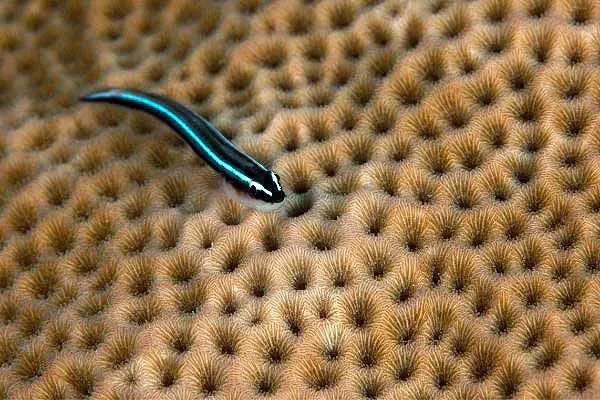
The neon goby is a great saltwater aquarium fish for beginners. This is a small fish with tons of personality. Neon gobies are “perching” fish. They sit on their pelvic fins, with their belly lined up flat along with the preferred structure in their territory. They are also sometimes characterized as “cleaner fish.”
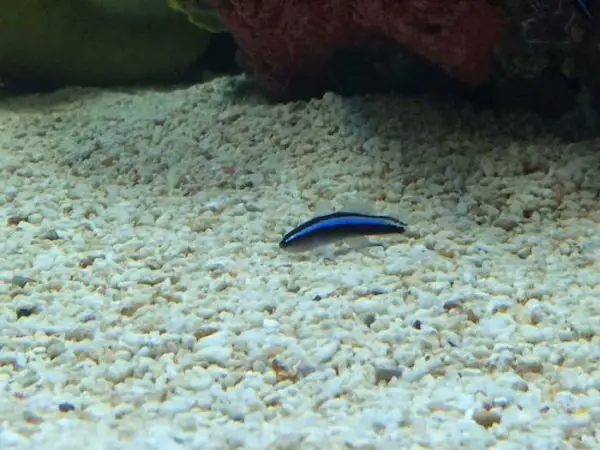
In your tank, you may see them perched, facing straight up or upside-down on a flat rock or the glass. They wait in their territory for morsels of food to float by or a larger fish (like a coral beauty angelfish, such as the one you’ll note below) to swim by and “request” a cleaning.
The larger fish will stop and hover while the neon goby darts around, looking for parasites or loose scales, picks them off, and makes a meal of the treasured tasty morsel.
Aquacultured neon gobies are easy to find, so efforts should be made to purchase tank-reared specimens over wild-caught.
In addition to being a fantastic saltwater aquarium fish for beginners all on their own merit, the cleaning behavior expressed by neon gobies can also help reduce aggression in the saltwater aquarium, according to research done on several different cleaner species.
Royal Gramma Basslet
The royal gramma basslet is a beautiful saltwater aquarium fish for beginners that is half purple and half yellow. As purple and yellow are the colors of royalty, the fish earned the common name: royal gramma. This fish is great for any size aquarium, even a nano-aquarium, and is, therefore, one of the best saltwater aquarium fish for beginners.
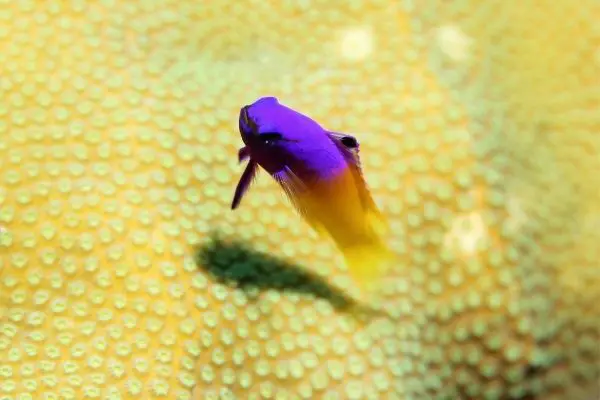
Please be careful not to confuse this fish with the royal dottyback, which shares similar coloration. In comparison, it’s aggressive, territorial, and (in my opinion) less attractive and NOT suitable to be a community fish. Given suitable rock-work or other structures in your tank, the royal gramma makes a great starter fish and will be a bold, colorful, comfortable addition to your tank.
Coral Beauty Angelfish
There are two kinds of angelfish available in the hobby today: “regular” angelfish and dwarf or pygmy angels. Regular angelfish species, like the emperor angelfish or queen Angelfish, are gorgeous fish. But they’re large, delicate, and NOT good saltwater aquarium fish for beginners, or even good fish for the advanced aquarist hoping to keep coral.
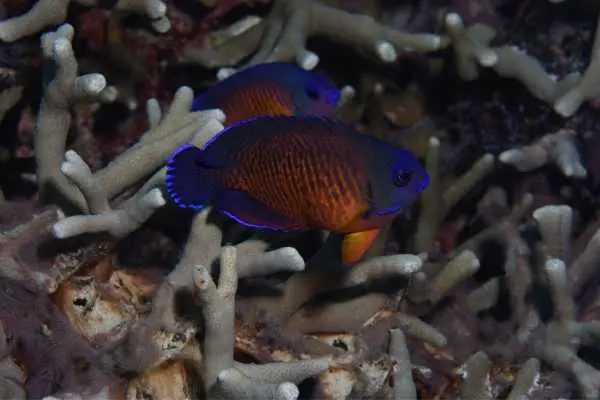
The pygmy angelfishes, however, are docile, reef-safe fish that only grow a few inches in length and are a great addition of color and perpetual motion. Some of the rarer species can be expensive to purchase and also more delicate. This is why the coral beauty angelfish is the perfect combination of hardiness, color, and value for the money. And it makes it an excellent saltwater aquarium fish for beginners.
The coral beauty is probably the most expensive fish on this list, though it’s reasonably priced by most saltwater reef fish standards. They are worth every penny and typically less expensive than other pygmy angels, like the fire angelfish.
Inspect pygmy angelfish closely in the tank at your local fish store because they’re susceptible to saltwater Ich.
Ocellaris Clownfish
This common clownfish is clearly one of the best saltwater aquarium fish for beginners.
It goes by several names: common clownfish, false percula clownfish, and ocellaris clownfish. It’s also sometimes incorrectly called the percula clownfish. Perculas are similar in appearance but typically command a higher price. “All the world loves a clown,” and no tank would be complete without a clownfish.
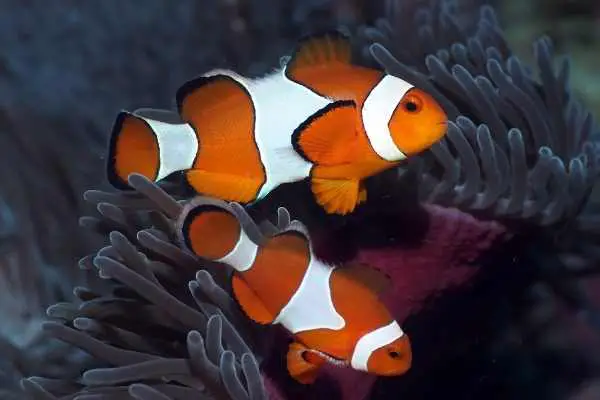
So why not start with the most popular and hardiest fish in the entire aquarium hobby – perhaps the most popular saltwater aquarium fish for beginners ever? Consider buying two ocellaris clownfish, and watch them pair up in your tank.
Saltwater Aquarium Fish for Beginners Chart
If you follow the stocking advice here, you will have a combination of small and medium-sized fish.
You’ll get a splash of orange, white, black, purple, yellow, pink, and neon white/blue. You will see clearly defined patterns, gradual fading patterns, and seemingly mismatched patterns.
You’ll also see stripes and polka dots and observe a mixture of behaviors, from the hyperactive, constantly grazing angelfish to the waddling ‘begging for food” clownfish to the perching and cleaning goby, to the darting gramma, and the slow, deliberate movements of the cardinalfish. Who knows, you may even witness your clownfish pair up and spawn!
If you’re on the fence about setting up your first saltwater reef tank, stop waiting and make it happen! I hope the summary chart below helps:
|
Name |
# Specimens |
| PJ Cardinalfish | Keep a single fish in a small-to-medium-sized tank. In a larger tank (75 gallons +), consider a small shoal of 3 to 5 fish. |
| Neon Goby | Keep a single fish or a mated pair. Two fish of the same gender will fight and should not be kept together. |
| Royal Gramma | Keep a single fish to avoid aggression. Also, try to avoid mixing similarly colored/sized fish, like the royal dottyback or diadem dottyback. |
| Coral Beauty Angelfish | The old adage is to keep only one angelfish per tank to avoid problems. |
| Ocellaris Clownfish | I recommend purchasing two fish. Part of the fun of clownfish is watching them pair up and establish a territory. The two, once bonded, will be a joy to watch as they spend most of their time together. Do not mix clownfish species, as serious aggression will result. |
Summary of Saltwater Aquarium Fish for Beginners
Setting up your aquarium for the first time is an awesome feeling. The excitement and anticipation are hard to contain. Make sure you take a moment to pause and reflect on your goals for your aquarium. Try to envision what it looks like once it is full and established. And then work backward to figure out the best order in which to add the fish.
If you make a bad choice now, you could be stuck with it for a very long time. Stick with the list of saltwater aquarium fish for beginners mentioned above, and you’ll be off to a great start.
If you would like to stray just a little bit from these conventional and very safe options, you might want to check out the 7 coolest saltwater fish for beginners instead.
For More Information
It is important to make sure that the saltwater fish you add to your marine aquarium are compatible with each other. A great resource to confirm the compatibility of different species of saltwater fish is a compatibility chart. There are many other great options in addition to the saltwater aquarium fish for beginners described here. Take your time, do some research, and pick great fish. If you want to explore beyond these 5 initial options, check out these other great beginner fish.
Further Reading
There are actually a lot of fish species that you absolutely should NOT consider as starter fish. But, unfortunately, every now and then, a well-intentioned but otherwise not well-informed individual will make a recommendation that could haunt you in the long run.
Don’t make that mistake. Instead, check out 5 starter fish to AVOID, or check out these books and these magazines that will help you get started.
Sometimes your starter fish get sick from parasites and infections. If so, you’ll want to check out this aquarium medication guide.
Last, but not least, if you’re thinking about branching out to corals, check out these lists of:

Leave a Reply